
Charles Darwin and his theories
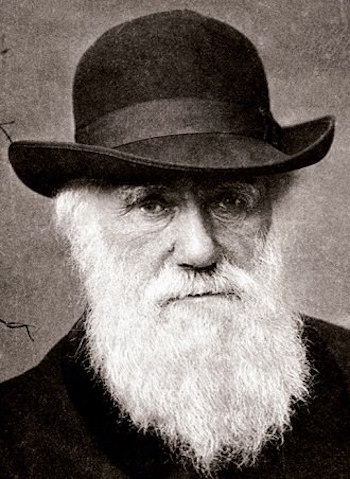
Charles Darwin was a naturalist who was a prolific at describing his findings in papers and published works. The basis of his works was a theory of evolution that itself evolved over the course of
his career and studies. Darwin pieced together information from his earliest studies to continuously expand upon his theory called "natural selection."
The root of Darwin's theory can be traced back to his time at Edinburgh university where he first became interested in invertebrates and the possibility that other creatures evolved from more simple
organisms like them. After his father sent transferred him to Christ's College in Cambridge, Darwin began to amass knowledge about botany and geology that would also help inform his evolutionary
theory.
Though Darwin began his life as a somewhat religious person, with ties to both the Unitarian and Anglican church, several concepts like the argument that nature was a process of "divine design"
did not seem to align with his rapidly increasing understanding of nature and geology. When the opportunity to contribute to scientific study as a naturalist on the HMS Beagle presented itself,
Darwin was excited to undertake that role. Though the voyage lasted many years and was tremendously arduous, it provided the basis of knowledge that Darwin would built upon to write his description
of natural selection.
Darwin's time aboard the HMS Beagle and his time spent off the ship during its voyage in South America was one of observation and collection. His journal excerpts and findings were periodically sent
back to Cambridge and he created a vast collection of specimens from fossils to small invertebrates. All were carefully maintained for proper appraisal at the end of the expedition. Along with these
creatures, Darwin explored the rise and fall of the land and grasped the massive time span of the earth and the changes it as an environment has experienced during its time span.
Upon his return as Darwin worked for years to compile the first edition of his theory of natural selection in his 1859 book On the Origin of Species. The framework of this theory is defined by
Merriam-Webster's dictionary as "the process whereby organisms better adapted to their environment tend to survive and produce more offspring."
Darwin assembled his theory from years of studies of creatures from small invertebrates, to plankton, to insects and then the collection of large extinct mammal fossils. It was paired with a
knowledge of geology and how the earth has evolved as an environment upon which every living thing has existed upon.
The final piece to make the theory complete was the relation of the natural world Darwin had studied and categorized mixed with an accessible theory on mankind. Essay on the Principle of Population,
by Thomas Malthus', was his primary influence in this area that changed the entire trajectory of his natural selection theory. The premise of the Malthus article was that there would never be enough
food supply to go around no matter how much was created, that populations increase too rapidly while food supplies increase arithmetically. This ruled charity to the poor as useless and the Whig
party of England had grasped onto this concept. A malthusian Poor Act was passed that attempted to stop poor men and women from breeding.
Darwin was having dinner with Harriet Martineau, who had created the propaganda for the Wig parties Poor Act, when he realized that an explosion in the size of population was imminent. Similar to in
the natural world, the large population would create more competition for shared resources and the battles created for those resources would weed out those that didn't succeed and thus deserve a
place in the population.
By combining his discoveries with his new Malthusian formula Darwin felt he had created the foundation of his natural selection theory. Despite society becoming ever so slowly radicalized and
embracing some agnosticism, it was unnerving for Darwin to be creating a theory that he knew would challenge the ingrained Anglican belief system in the United Kingdom. He had constant inner
turmoil about his own belief in God and how he would be judged or possibly persecuted by publicly promoting a theory that disproved religious law.
It took a long time after the initial sketch of his theory until Darwin felt confident publishing it, especially after his wife's reaction which was one of shock. He suggested to his wife that
if he died she should benefit from the theory by paying to publish it posthumously. He moved to the countryside with the family and kept the theory secret from nearly everyone until the 1850s.
During his period of seclusion Darwin continued working on his studies, focusing on work about pollination, barnacles and South American coral reefs and geology. He created a series of four
monographs on an obscure hermaphroditic barnacle and became a world authority on the subject. With the awarding of the Royal Society's Medal in 1853 Darwin now had the clout and the confidence
to release his theory on natural selection.
His decision to finally come out of his intellectual secrecy was buoyed by the support of biologist Thomas Henry Huxley, a freethinker who insisted that the social climate was ready now to listen
to Darwin's theories. This coincided with Darwin's decision to include a labor and competition analogy to describe how genes are divided among evolutionary branches when overcrowded. He tested
natural selection by keeping pigeons and testing their chicks for similarities to ancestral relations. He was testing and perfecting the analogy of his theory and readying to present it to the
population.
Darwin at first ambitiously set out to publish a three volume series and worked through the birth of his tenth child. When he received a letter from Alfred Russel Wallace, who was well respected
and working collecting specimens on the Malay Archipelago, his noticed many similarities between the theories that Wallace described. He decided he needed to abridge the three volumes and make the
theory into a presentation that could be completed faster.
In 1859 Darwin's explanation of natural selection theory was published and entitled "On the Origin of Species." In following years Darwin would publish updated versions of the text as his knowledge
and research on this theory was his life's work.
Darwin is best known for his natural selection theory, but also explored a few others in his life. Up until his death he did not stop exploring new ideas, and in 1871 published The Descent of Man,
and Selection in Relation to Sex. This book applied his theory of evolution to his theory on sexual selection.
It may be observed that Darwin wished to elaborate on his theory of evolution as it related to humanity. He observed many facets of humanity that troubled him during his quest with the HMS Beagle
and must have searched for many years for an avenue in which to discuss his theory as relating to society, sex, and the human race.
Darwin wrote prolifically but his theories all surrounded the base of his magnum opus, natural selection. He was a groundbreaking intellectual force that insisted on nothing but his own greatest
work being thoroughly tested before he made it his own official theorem.